

Which Two Processes Lead To Variations In The Genetic Makeup Of The Gametes?
Learning Outcomes
- Understand how meiosis contributes to genetic diversity
The gametes produced in meiosis aren't genetically identical to the starting cell, and they also aren't identical to one some other. Every bit an example, consider the meiosis Ii diagram above, which shows the end products of meiosis for a uncomplicated cell with a diploid number of 2due north = 4 chromosomes. The 4 gametes produced at the end of meiosis Two are all slightly different, each with a unique combination of the genetic fabric present in the starting cell.
Every bit it turns out, there are many more than potential gamete types than merely the 4 shown in the diagram, even for a simple cell with with but four chromosomes. This diversity of possible gametes reflects 2 factors: crossing over and the random orientation of homologue pairs during metaphase of meiosis I.
- Crossing over. The points where homologues cross over and exchange genetic fabric are chosen more or less at random, and they will be dissimilar in each cell that goes through meiosis. If meiosis happens many times, equally it does in human ovaries and testes, crossovers will happen at many dissimilar points. This repetition produces a wide diversity of recombinant chromosomes, chromosomes where fragments of DNA have been exchanged between homologues.
- Random orientation of homologue pairs. The random orientation of homologue pairs during metaphase of meiosis I is another important source of gamete diversity.
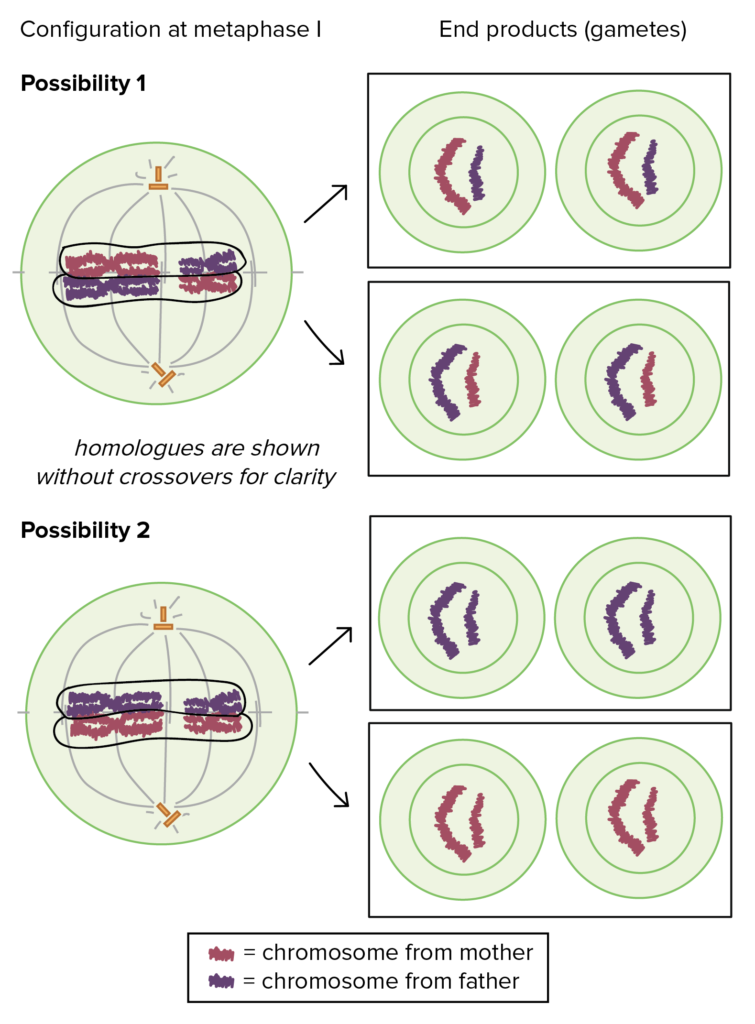 What exactly does random orientation mean hither? Well, a homologous pair consists of ane homologue from your dad and one from your mom, and yous have 23 pairs of homologous chromosomes all together, counting the X and Y equally homologous for this purpose. During meiosis I, the homologous pairs will separate to form two equal groups, but it'south not usually the example that all the paternal—dad—chromosomes will get into one group and all the maternal—mom—chromosomes into the other.
Instead, each pair of homologues will effectively flip a coin to decide which chromosome goes into which group. In a cell with but two pairs of homologous chromosomes, like the one at correct, random metaphase orientation allows for ii2 = 4 different types of possible gametes. In a human prison cell, the aforementioned mechanism allows for two23 = viii,388,608 different types of possible gametes[1]. And that'due south not fifty-fifty considering crossovers!
Given those kinds of numbers, it's very unlikely that whatever 2 sperm or egg cells made by a person volition be the same. It'south even more unlikely that you and your sister or blood brother will be genetically identical, unless you happen to be identical twins, thanks to the process of fertilization (in which a unique egg from Mom combines with a unique sperm from Dad, making a zygote whose genotype is well beyond ane-in-a-trillion!)[2].
Meiosis and fertilization create genetic variation past making new combinations of gene variants (alleles). In some cases, these new combinations may make an organism more or less fit (able to survive and reproduce), thus providing the raw material for natural selection. Genetic variation is important in allowing a population to suit via natural selection and thus survive in the long term.
Try It
Contribute!
Did you lot have an thought for improving this content? We'd love your input.
Improve this pageLearn More

Which Two Processes Lead To Variations In The Genetic Makeup Of The Gametes?,
Source: https://courses.lumenlearning.com/wm-biology1/chapter/reading-genetic-variation-in-meiosis/
Posted by: witherswasseene.blogspot.com
0 Response to "Which Two Processes Lead To Variations In The Genetic Makeup Of The Gametes?"
Post a Comment