

Can You Put Makeup Over A Bandage
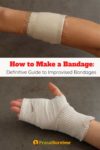
There are a lot of types of bandages but they all serve the same purpose: to assist go on a wound clean so information technology can heal faster.
Ideally, you should always take a supply of sterile bandages in your get-go help kit (I even go on a few in my wallet for small injuries on the go). But, if you are out of bandages, it's actually pretty piece of cake to make your own bandages.
Some commonly-recommended materials, similar tissues, toilet newspaper and duct record, do NOT work well for bandages and could cause infection.
So, here's what you demand to know to make your own bandage at home with improvised materials.
Step ane: Stop the Bleeding
Before you worry about bandaging the wound, you need stop the bleeding. Elevate the wound to a higher place the heart and apply pressure. Ideally you lot would apply pressure with a clean compress, such as a heavy gauze pad.
However, at this phase, stopping the haemorrhage is more than important than cleanliness. In a pinch, use any absorbent material will do. Towels, t-shirts, or even socks work.
Avoid using newspaper towels or toilet paper because these disintegrate easily and can go into the wound. But, over again, the main goal is to stop the haemorrhage. In an emergency, grab whatsoever materials are nearby and apply pressure.
If direct pressure doesn't end the bleeding, use a tourniquet.
Step 2: Set up the Wound
Earlier applying the bandage, you'll need to:
- Wash your easily.
- Clean the wound.
- Apply antiseptic ointment or Vaseline to the wound. This aids healing, keeps the wound moist and prevents the dressing from sticking to the wound.
Step three: Utilise a Wound Dressing
Bandages are made out of two parts: a dressing and the bandage.
The dressing goes directly confronting the wound and the bandage is what holds the dressing in place. With adhesive bandages (aka Ring-Aids), the dressing is the white area in the centre of the gluey strips.
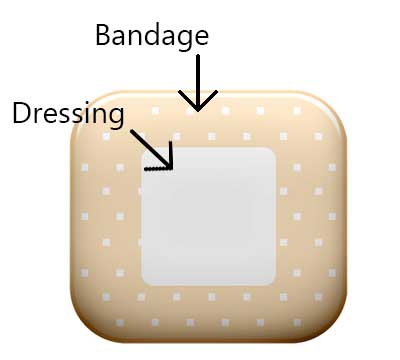
Applying the dressing is piece of cake. Merely put the middle of the dressing over the wound. The dressing should be large plenty to cover the unabridged wound plus some of the healthy tissue surrounding the wound.
See here for more than on the unlike types of bandages.
How to Improvise a Wound Dressing
Because the dressing touches the wound, it must be:
- Sterile (or at least very clean)
- Non-agglutinative
- Thick enough to absorb claret
- Larger than the wound
- Lint-free
Ideally, the dressing cloth is besides white and so you lot can see whatever signs of infection on information technology better.
Some good improvised wound dressings are:
- Linen fabric, such as from pillow cases or bed sheets, folded several times
- Cotton cloth, folded several times
- Feminine hygiene pad
- Makeup removal pad
- Tea bags
*Plastic cling wrap works slap-up as a temporary bandage for burn wounds. Information technology keeps the wound clean until you can become proper bandages. Read nigh how to treat burns here.
Do NOT Use Tissues or Toilet Paper for Making Bandages
A lot of people recommend using tissue or TP for making your own cast. This is a very bad idea because these materials disintegrate when they go wet, causing fibers to arrive the wound. Information technology is very difficult to remove these fibers from the wound and they could even lead to an infection.
Too Do NOT Apply Cotton fiber Assurance for Bandages
Cotton balls are very fibrous. You lot can sometimes get away with using cotton balls on small wounds. But, if the wound is large, lilliputian cotton fiber fibers tin can end up deep in the wound. This can irritate the wound and lead to infection. Cleaning out all those piddling cotton brawl threads is not a pleasant feel!
What about Plants Leaves as Improvised Bandages?
Opposite to what yous'll read on some wilderness medicine websites, information technology'due south not smart to use found leaves for bandaging wounds. Leaves are often very dirty. Even if the leaf looks clean, it contains numerous types of microorganisms which could get into the wound and cause infection.
For small-scale wounds, I have used mullein leaves as an improvised Band-aid. The leaves are very soft and absorbent so work well to control bleeding (they are also dandy as a toilet paper alternative). However, I would never use this on a large wound unless I was actually desperate because the risk of infection is too bully.
Sterilizing Improvised Wound Dressings
For small wounds, y'all can often skip this footstep so long as the dressing is very clean. If the wound is very large or at risk of infection though, so you'll want to brand sure the dressing is sterile. The easiest fashion to sterilize a dressing is to iron it.
Kickoff iron the ironing board to sterilize it. So dampen the dressing textile with filtered water. With the iron at high rut, iron each side of the dressing at to the lowest degree three times. The atomic number 26 should be on its highest setting
You tin can as well sterilize bandage dressings by putting them in tinfoil and baking them in the oven at 300F for xxx minutes. Wait until it has cooled to apply.
What almost sterilizing dressings in the field?
Hither is where things get catchy. Let's say that you become injured while camping and don't have any clean materials to use every bit a bandage. Bandaging the wound with a dirty piece of t-shirt could lead to infection. But leaving the wound uncovered could also pb to infection.
Considering of these problems, it's actually of import that you ever bring make clean bandages with you when going into the field. Make certain you have a first help kit with items in your issues out bag first assistance kit.
Sterilizing Bandages with Boiling
You tin sterilize wound dressings by boiling them. This is what ground forces doctors do when gauze is scarce during wartime. However, it takes a long time for bandages to dry. Applying moisture bandages to a wound is a terrible idea as it creates a breeding ground for infection.
Thus, the only time boiling bandages makes sense is if you already accept some sterile gauze on hand. You'd first use the sterile gauze to wearing apparel the wound. Then you'd boil some strips of fabric and advisedly hang them to dry. When it came fourth dimension to change the dressing, you lot'd use these now-sterile cloths. The original gauze could even be reused if you washed and boiled it.
Stride 4: Apply the Bandage
The cast is what holds the wound in place. Bandages as well can employ pressure to the wound to assist command bleeding.
Considering the bandage doesn't come in direct contact with the wound, it doesn't have to exist sterile. All the same, it does need to be large plenty to cover the dressing and hold information technology in identify.
Depending on the wound type and location, you might need a bandage which is stretchy and can provide compression. For instance, tape bandages don't work well over joints and can even cause the wound to reopen.
The best improvised bandages are:
- Agglutinative tape:Just tape the dressing in place
- Long strips of fabric:Wrap around the dressing
- Bandana:Cross over the dressing and necktie in identify
- Socks with the toe area cut off:Put over dressing on arms or legs
Improvised Tape Bandages:
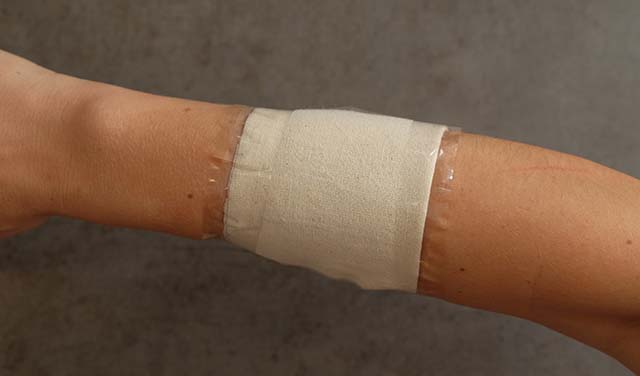
Medical tape is used to tape dressings straight onto the skin. This is the easiest fashion to brand a bandage on parts of the body which don't move. Unfortunately, tape bandages don't work well on joints because they can pull on the skin and cause the wound to open over again.
- What to use: Clear packing tape, masking tape, painter's tape
- Injuries to: Arms, legs, torso, breast (practise not use over joints)
- How to apply: Simply tape the edges of the dressing down. Don't put tape completely over the dressing; you want the wound to "breathe" at fleck.
Tin can You lot Utilise Duct Tape to Bandage a Wound?
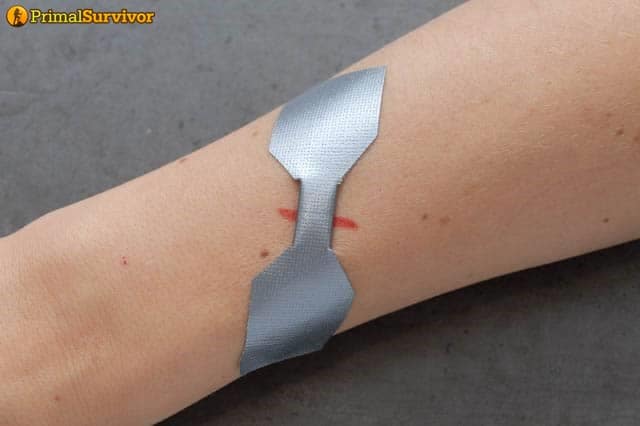
A lot of people recommend duct tape for making bandages. While it certainly works for holding the dressing in identify, the problem is that it works also well. When you lot become to change the cast, the duct tape pulls on the pare. The pulling action can cause the wound to reopen and starting time bleeding again.
I wouldn't recommend duct tape for bandaging unless you really didn't have annihilation else. The one exception is if you are making DIY butterfly bandages. This type of bandage is used on narrow gaping wounds (such as knife wounds). No dressing is needed: the cast simply holds both sides of the wound together. Come across how to brand a butterfly bandage here.
Improvised Gauze Roller Bandages:
Roller bandages are long strips of material (unremarkably gauze). Considering they wrap around the injured area multiple times, they are great at belongings dressings in place, peculiarly on areas like joints.
- What to use: Long strips of breathable fabric, such equally linen
- Injuries to: Arms, legs, hands, feet, shoulders or joints
- How to apply: Commencement with an "anchor wrap" around the dressing. Then continue wrapping the dressing. Depending on the location, you might use circular, spiral, recurrent, effigy-viii or opposite spiral bandaging methods (come across this guide for images).
Improvised Elastic Compression Bandage:
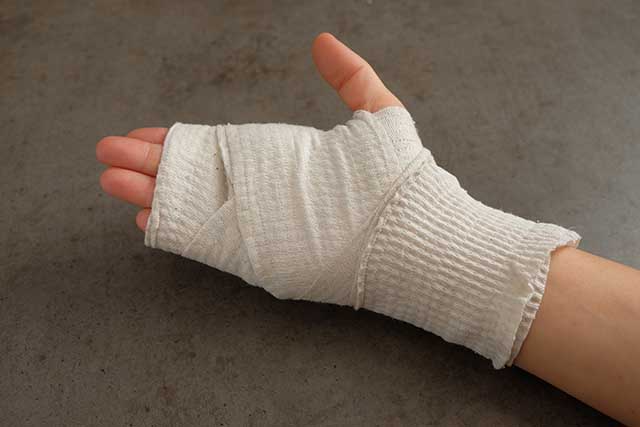
Like gauze roller bandages, elastic bandages are also long strips of fabric. The difference is that they are made from a stretchy fabric. The stretch allows you to apply force per unit area to the wound to control haemorrhage. Pressure as well helps support tissues, such as in sprains or fractures. The epitome shows an elastic cast with figure-8 wrapping on a paw injury. It does a swell job of holding dressings in place, immobilizing fingers and stabilizing the wrist.
- What to apply: Long strips of stretchy textile, such as cotton wool t-shirts
- Injuries to: Artillery, legs, hands, feet, shoulders or joints
- How to apply: Apply like you would apply a gauze roller bandage, but with pressure to wound.
Improvised Tubular Bandages:
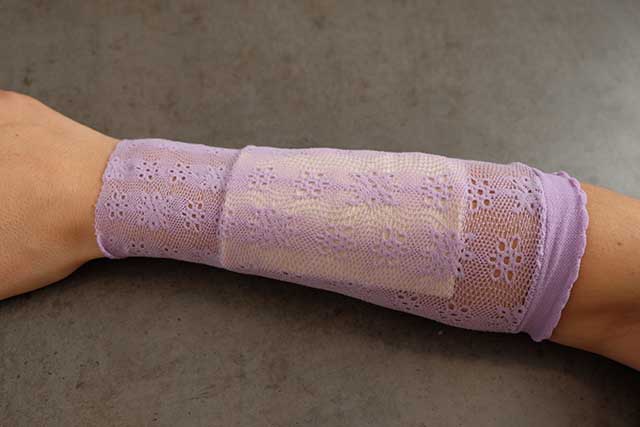
Tubular bandages utilize pressure level all around the wound surface area, so are particularly good for decision-making pressure level. They also practice a decent job of property dressings in place, especially in areas like joints which move around a lot. In the image, I used my daughter'due south stocking because the small size applied good pinch (yep, it make me expect like Madonna from the 80s!).
- What to apply: Sock with the toe area cut off
- Injuries to: Wounds on the forearm, lower legs, knees, elbows, ankle, or wrist
- How to use: If possible, tape the dressing down starting time. Stretch the bandage open and put information technology to a higher place the injured area. And then carefully pull the improvised bandage over the dressing.
Improvised Triangle Bandages:
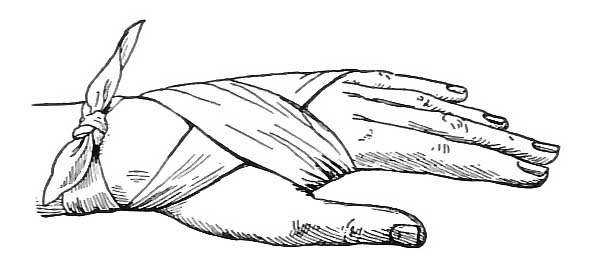
Triangle bandages are useful for certain injuries which would be hard to wrap with other types of bandages. They are tied in place, so the knot tin be used to apply force per unit area to wounds to control bleeding.
- What to utilize: Fabric cutting into a triangle
- Injuries to: Easily, optics, head injuries or when you need to apply pressure
- How to use: Center over the dressing, cross the edges around the limb/injured area, and necktie in place. See how to use a triangle bandage here.
Practice you have any other suggestions for making your own wound dressings or bandages? Let us know in the comments.

Can You Put Makeup Over A Bandage,
Source: https://www.primalsurvivor.net/how-to-make-bandage/
Posted by: witherswasseene.blogspot.com
0 Response to "Can You Put Makeup Over A Bandage"
Post a Comment